Home Office
Best Under-Desk Footrest in 2026: Who Needs One and What to Buy
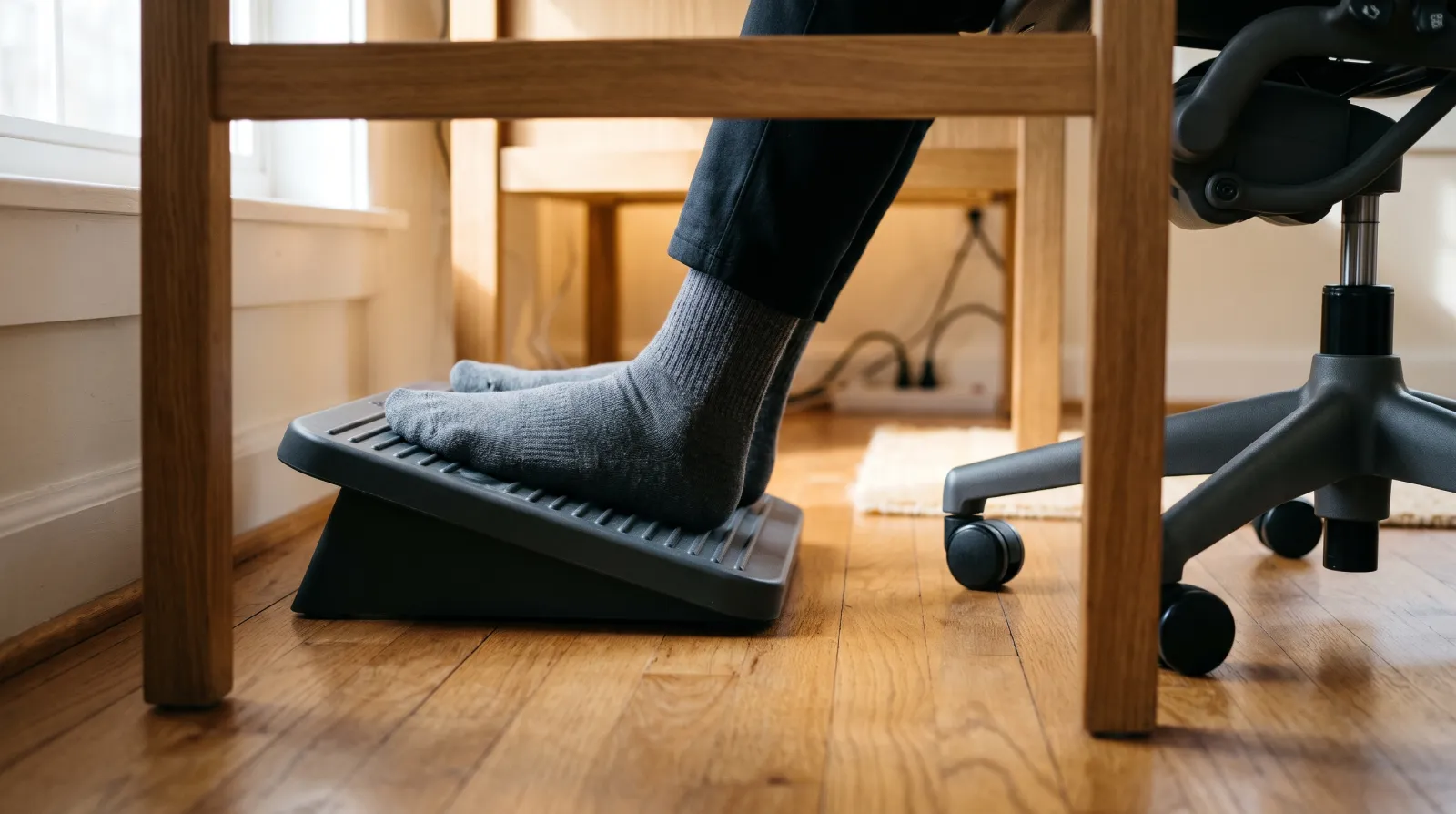
A footrest fixes one specific problem: your chair has to be high enough for the desk, and then your feet don’t sit flat on the floor. Here’s how to tell if that’s you, how tall a footrest you need, and which type to buy.
As an Amazon Associate, Before You Cart earns from qualifying purchases. Read our affiliate disclosure.
The short answer
- Do you need one? Only if your feet don’t sit flat once your chair is high enough for your desk. OSHA calls for a footrest in exactly that case.
- Best overall: ComfiLife Foot Rest, a soft memory-foam footrest with a removable 2-inch layer and a washable cover ($59.95 at ComfiLife, Nov 2026).
- Best adjustable platform: Fellowes Ultimate Foot Support, three heights from 4 to 6.5 inches, up to 25° tilt, and it rocks (about $60 at Staples, Nov 2026).
- Best budget: Mind Reader adjustable footrest with massage rollers ($34.99 at Mind Reader, Nov 2026).
- Best premium: Humanscale FR300 Foot Rocker, a hardwood and steel rocker, $211 list.
Do you need a footrest?
A footrest solves a mismatch between your chair, your desk and your legs. Most desks are a fixed height. To type with your elbows at desk height, a shorter person has to raise the chair, and then their feet dangle or only the toes touch the floor.
- What OSHA says: a seat that’s too high can leave your feet unsupported or push you forward off the backrest, which can lead to fatigue, restricted circulation, swelling, numbness and pain. If the seat can’t be lowered because the keyboard or monitor would end up too high, OSHA says to use a footrest for stable support.
- The fit test: OSHA says chair height is right when the whole sole of your foot rests on the floor with the back of your knee slightly higher than the seat. Mayo Clinic says the same in plainer terms: feet flat on the floor, or a footrest so your thighs are parallel to the floor.
- Seat too deep: if the front edge of your seat presses behind your knees, OSHA lists a footrest as one fix, because raising your knees slightly takes pressure off the back of your legs.
Try this first: if your chair or desk can change height, adjust them before buying anything. Our office chair guide covers seat height and depth, and a standing desk can drop low enough that many shorter people don’t need a footrest at all.
How tall a footrest you need
- Raise your chair until your elbows sit at about desk height with relaxed shoulders.
- Sit back against the backrest with your thighs about parallel to the floor.
- Measure from the floor to the soles of your feet (or shoes, if you wear them at your desk). That number is your target footrest height.
Then match it to the ranges below. Under about 4 inches, look at the low settings on the Kensington (3.5 inches) or Humanscale (3.75 inches). Around 4 to 6 inches, almost everything here works. Over 6 inches, you need the tallest settings: the ComfiLife at 6 inches, ErgoFoam at 5.9, Fellowes at 6.5 or Humanscale at 6.75. If your number changes with shoes or a second chair, buy adjustable.
Foam, adjustable or rocking
| Footrest | Type | Height | Tilt or rock | Price |
|---|---|---|---|---|
| ComfiLife Foot Rest | Memory foam | About 4 or 6 in (removable 2 in layer) | Fixed wedge | $59.95 at ComfiLife |
| ErgoFoam Adjustable | Foam | 3.9 or 5.9 in | Flips over to rock | About $40 to $50 at ErgoFoam |
| Fellowes Ultimate Foot Support | Plastic platform | 4, 5.25 or 6.5 in | Up to 25° tilt, rocks | About $60 at Staples |
| Kensington SoleMate Pro Elite | Platform, foot pedal | 3.5 to 4.7 in | 0° to 18° tilt | Check the listing |
| Humanscale FR300 | Hardwood and steel | 3.75 to 6.75 in | Rocks on ball-bearing rollers | $211 list |
| Mind Reader (massage rollers) | Plastic platform | Adjustable, about 4.3 in tall | Tilts | $34.99 at Mind Reader |
- Foam: soft, silent and comfortable with socks or bare feet. Height changes in big steps by adding or removing a layer. Covers come off for washing.
- Adjustable platforms: plastic or metal decks that lock at set heights and angles. Better if you wear shoes at your desk or need a precise height.
- Rocking: the platform tips back and forth so your ankles and calves keep moving. Good for restless sitters; some can also lock flat.
Our picks
Picks are based on maker specs, retailer listings and workstation guidance, not hands-on testing.
ComfiLife Foot Rest
For: most people who want a comfortable footrest for socks or bare feet.
High-density memory foam · 17.5 × 12 × 6 in · detachable bottom adds or removes 2 in of height · removable, machine-washable cover · non-slip bottom · black, gray or navy · $59.95 at ComfiLife (Nov 2026)
Pros
- Soft and quiet
- Two heights from one footrest
- Washable cover
Cons
- Only two height settings
- No tilt adjustment
ErgoFoam Adjustable Foot Rest
For: people who want soft foam but also like to rock their feet.
Foam teardrop shape · 17.3 × 11.5 × 5.9 in · 3.9 or 5.9 in height by adding or removing a section · flip it over to use it as a rocker · machine-washable velvet cover (mesh cover also sold) · limited lifetime warranty · about $40 to $50 at ErgoFoam (Nov 2026)
Pros
- Rocker and fixed rest in one
- Limited lifetime warranty
- Mesh version for warm feet
Cons
- Two heights only
- Foam can be too soft under shoes
Fellowes Ultimate Foot Support
For: shoe wearers and anyone who wants to fine-tune height and angle.
Plastic platform with massage bumps · about 17.75 × 13.25 in · 3 heights: 4, 5.25 and 6.5 in · up to 25° tilt · rocking motion · model 8067001 · $60.19 at Staples (Nov 2026)
Pros
- Widest height range of the platforms here
- Tilts and rocks
- Easy to wipe clean
Cons
- Hard surface with bare feet
- Bigger footprint than foam
Kensington SmartFit SoleMate Pro Elite
For: shorter-gap users and shared desks, since a foot pedal changes the setting from your chair.
3.5 to 4.7 in height · tilt 0° to 18° · locking foot-pedal control · wide platform · easy-clean fabric surface · SmartFit sizing system · 2-year limited warranty
Pros
- Change height and tilt with your foot
- Wide platform for a wider stance
- 2-year warranty
Cons
- Tops out at 4.7 in
- Price varies; check the listing
Mind Reader Adjustable Foot Rest with Massage Rollers
For: a basic, low-cost footrest that tilts and has rollers for your soles.
Plastic · about 18 in wide and 4.3 in tall · adjustable height and tilting platform · center massage rollers · textured sides · 5.5 lb · $34.99 at Mind Reader (Nov 2026)
Pros
- Low price
- Massage rollers
- Tilting platform
Cons
- Maker lists little detail on the height range
- Plastic feel
Humanscale FR300 Foot Rocker
For: people who want a durable rocker that will outlast plastic and foam.
Solid hardwood platform on a steel frame · 16 × 11.875 in · 3.75 to 6.75 in height range · ball-bearing rollers for gentle rocking · non-skid surface · $211 list at Humanscale
Pros
- Three inches of height adjustment
- Hardwood and steel build
- Encourages movement (Humanscale)
Cons
- Expensive
- Rocks by design, so feet never sit fully still
The verdict
First check whether you need one: if your feet sit flat with your chair set for your desk, skip it. If they don’t, measure the gap and buy a footrest that covers it. The ComfiLife Foot Rest is the most comfortable choice for most home offices. Get the Fellowes Ultimate Foot Support if you wear shoes or want tilt, the Mind Reader to spend the least, and the Humanscale FR300 if you want a rocker built to last.
Frequently asked questions
Do I need a footrest under my desk?
Only if your feet don’t rest flat on the floor once your chair is at the right height for your desk. OSHA says that if you can’t lower the seat without making the keyboard or monitor too high, you should use a footrest so your feet have stable support. If your feet already sit flat with your thighs about level, you don’t need one.
How high should a footrest be?
Set your chair for the desk first, then measure the gap between the floor and the soles of your feet while your thighs are about parallel to the floor. That gap is the height you need. Most footrests cover roughly 3.5 to 7 inches, so pick one whose range includes your number, or an adjustable one if you’re not sure.
Is a foam or an adjustable footrest better?
Foam footrests like the ComfiLife and ErgoFoam are soft, quiet and good with socks or bare feet, with two height settings. Plastic or metal platforms like the Fellowes and Kensington adjust height and tilt more precisely and hold up better under shoes. Choose foam for comfort and platforms for exact fit.
Are rocking footrests worth it?
They let you move your feet and lower legs while you sit. Humanscale says its FR300 rocker engages lower leg muscles to help circulation, and the Fellowes Ultimate Foot Support and ErgoFoam (flipped over) also rock. If you prefer your feet to stay still, choose a fixed-angle setting or a foam block.
Do I need a footrest with a standing desk?
Usually not. With a height-adjustable desk you can lower the desk until you can sit with your feet flat and the keyboard at elbow height, which is the fix OSHA prefers. A footrest makes sense when the desk can’t go low enough for you.
Sources
This guide is based on OSHA and Mayo Clinic workstation guidance, maker product pages and retailer listings. We have not tested these products ourselves. Specs and prices were checked on November 26, 2026; check Amazon for today’s price.
- OSHA eTools: Computer workstations, chairs (opens in a new tab)
- Mayo Clinic: Office ergonomics, your how-to guide (opens in a new tab)
- ComfiLife: Foot Rest product page (checked Nov 2026) (opens in a new tab)
- ErgoFoam: Adjustable Desk Foot Rest (checked Nov 2026) (opens in a new tab)
- Staples: Fellowes Ultimate Foot Support 8067001 (checked Nov 2026) (opens in a new tab)
- Kensington: SmartFit SoleMate Pro Elite foot rest (opens in a new tab)
- Humanscale: FR300 Ergonomic Foot Rocker (opens in a new tab)
- Mind Reader: Foot Rest with Massage Rollers (checked Nov 2026) (opens in a new tab)